Judaism is a religion of contrasts. The leap from one of the most solemn days of the year (Yom Kippur) to one of the most joyous (Sukkot) in the space of one week is a perfect example.
 Yom Kippur we spend 25 hours fasting and reflecting on the past year. Then we get busy building an outdoor structure, called a Sukkah (Soo-kah – NOT sucka) for the holiday of Sukkot, loosely translated as “Feast of Booths/the Tabernacles”. (“Sukkot” is plural of Sukkah.)
Sukkot lasts a full week and is a festival with two meanings. First, the Sukkah is reminiscent of the type of dwellings in which the Israelites slept during their 40 years of wandering in the desert with Moses during the Exodus. Throughout the holiday the Sukkah substitutes for the living area of the house, and all meals are eaten there.
Secondly, the holiday celebrates the season of the harvest, which helps makes sense of the items used during this happiest of holidays… (more about that later on… ).
 The Sukkah itself consists of three or four walls (no higher than about 30 feet and no lower than about 40 inches). Size-wise, a Sukkah cannot be smaller than 22.4 inches by 22.4 inches. At its smallest, it needs to be large enough to hold a person's head and torso, and a small table. There is no size limit in how large a Sukkah may be. It can be made of any material, as long as it can be easily dismantled, so it is interpreted as non-permanent. I’ve seen Sukkah walls made of canvas, wood, tarps, and plastic sheeting. There are even “popup” Sukkot for those who find themselves traveling during the holiday.

The roof is called a s’chach (that’s two hard, guttural “ch” sounds). This consists of geographically appropriate unfinished plant material laid across raw wooden beams. Again, variety plays a role in this: corn stalks in the Midwest, evergreen branches in New England, palm fronds in the warmer climes, and, well, I hope you get the idea. The important part about the s’chach is that it consist of natural materials with enough space between so you can see stars through the branches when you look up at night, but not so much that there’s more sunlight than shade during the day.

One of the great mitzvahs (blessings) of the holiday is the shaking of the lulav and the etrog, over which members of the household recite a blessing each day of the holiday period, with the exception of the Sabbath. The lulav collectively refers to a grouping of greenery consisting of three myrtle twigs, two willow twigs, and a palm frond bound together. The etrog is an aromatic cousin of the lemon called a citron.
 You can get more specific information on the specific way to bind and use the lulav and the etrog, including the prayers here.
Of course the great fun of Sukkot is the chance to decorate your Sukkah to your taste. Just about anything goes including popcorn balls, clove-studded fruit, paper cut designs, fruit made out of paper-maché, pages from your preschooler’s coloring book, and so on and so forth.
The even greater fun is inviting company (ushpizin) over to dine in the Sukkah. Sukkot is all about eating, drinking and being merry with friends and family. So, participate in the mitzvot and the joy!
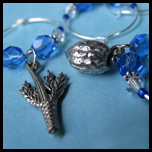
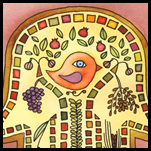
Adorn your home, your glasses, your walls, or your Sukkah with finds from these great EtsyChai artists:
Come on all you Etsy artists – What are your Sukkah decorating suggestions?
April
http://agru.etsy.com/ (ceramics shop)
http://surlespointe.etsy.com/ (upcycled dance gear)
http://agru.blogspot.com/ (ceramics blog)
http://agru.livejournal.com/ (nature blog)